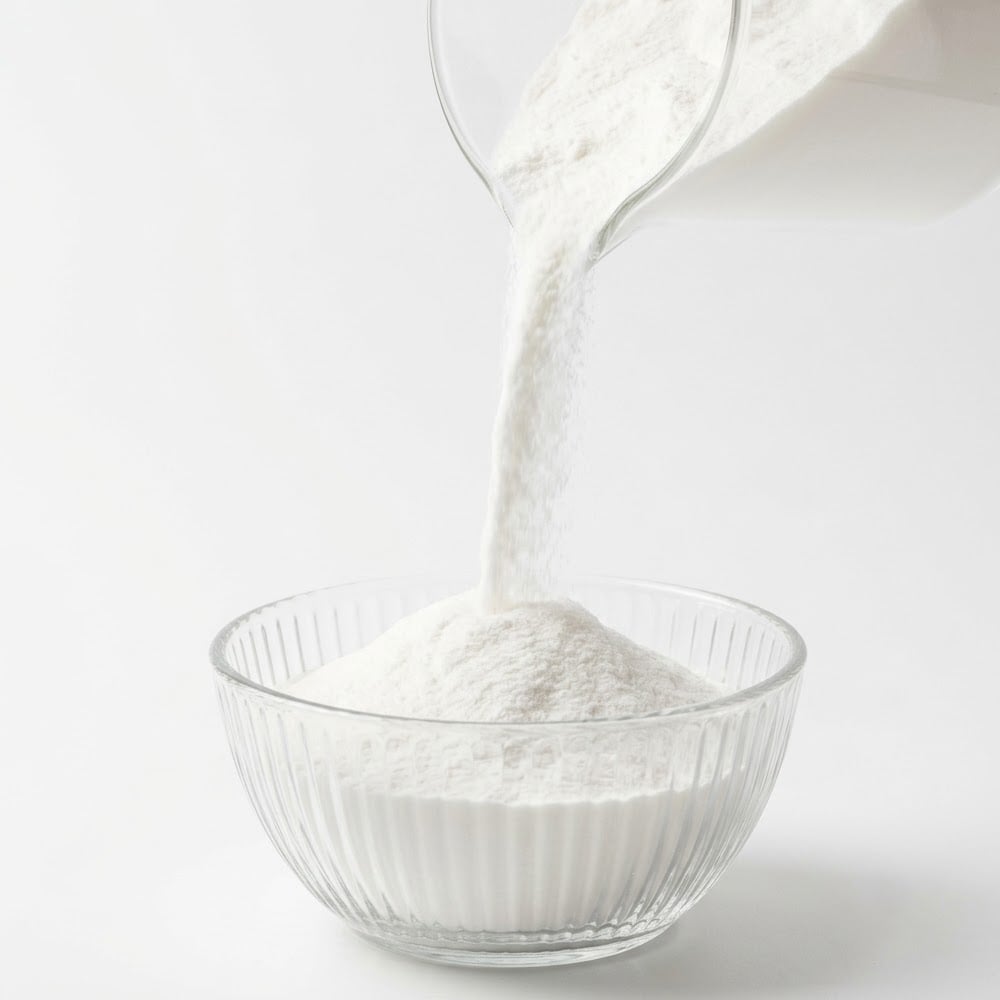
Mannitol is a naturally occurring sugar alcohol (polyol) derived through catalytic hydrogenation of mannose or glucose-based carbohydrates. As a white crystalline powder, Mannitol offers a distinctive combination of functional properties that have made it a valued ingredient across pharmaceutical, food, and nutraceutical manufacturing for decades. Buyers value Mannitol for its low hygroscopicity, mild and pleasant sweetness, characteristic cooling sensation, excellent chemical stability, and broad formulation compatibility — properties that account for its continued demand in both highly regulated pharmaceutical applications and food product development.
From a procurement perspective, what distinguishes Mannitol from other sugar alcohols is its versatility across very different manufacturing environments. Mannitol serves pharmaceutical tablet manufacturing as a direct-compression excipient, sugar-free confectionery production as a bulking agent and cooling enhancer, and nutraceutical powder formulation as a carrier and texture modifier. Understanding which application your production line requires — and which Mannitol specification and grade follow from that — is the first and most important step before sourcing Mannitol for industrial use.
Before reviewing the Mannitol application areas below, here is a question worth considering early in your sourcing process: what does your end formulation actually require from Mannitol — excipient performance, sensory contribution, or structural function? The answer determines not just how much Mannitol you use, but which grade and specification you need to source.
Pharmaceutical Manufacturing: Mannitol is established as a pharmaceutical excipient under major pharmacopoeial standards including USP, EP, and JP, each of which specifies purity requirements, impurity limits, and test methods that go substantially beyond food-grade Mannitol specifications. In tablet manufacturing, Mannitol is used as a filler and binder in direct compression formulations, taking advantage of its compressibility and low hygroscopicity. In chewable tablet and orally disintegrating tablet formulations, Mannitol additionally contributes pleasant mouthfeel and a cooling sensation. Lyophilization applications use Mannitol as a bulking agent and cryoprotectant. Buyers in the pharmaceutical segment typically require batch-to-batch Mannitol consistency documentation, pharmacopoeial certificates of analysis, and quality system evidence aligned with GMP requirements.
Sugar-Free Confectionery and Food Products: The sugar-free and reduced-sugar food market continues to grow as consumer awareness of dietary sugar intake increases globally. Mannitol fits naturally into this trend as a bulk sweetener and texturizing agent for sugar-free confectionery, chewing gum, hard candy, and powdered products. Mannitol's low glycemic contribution and dental-friendly profile make it relevant for health-positioned product claims, though the applicable regulatory framework for specific Mannitol claims varies by market and should be independently verified before product launch.
Nutraceuticals and Functional Foods: In nutraceutical powder products and supplement formulations, Mannitol serves as a carrier, flow aid, and taste modifier. Its stability and neutral chemical behavior support Mannitol's compatibility in multi-ingredient formulations where interaction effects need to be minimized.
Healthcare and Specialty Applications: Mannitol's osmotic properties are utilized in specialized medical and healthcare formulations. These applications typically carry the strictest quality and documentation requirements, and sourcing Mannitol for these segments should always begin from confirmed pharmacopoeial specifications.
The Mannitol grade selection decision is not simply a cost optimization exercise. In practice, the choice between pharmaceutical-grade Mannitol and food-grade Mannitol comes down to your formulation's sensitivity to purity parameters, your target market's regulatory requirements, and your own quality system's documentation obligations.
Pharmaceutical-grade Mannitol is produced and tested to pharmacopoeial specifications — USP, EP, or JP depending on your target markets — and comes with the documentation chain required for pharmaceutical raw material qualification: Mannitol certificates of analysis, GMP compliance evidence, and typically more extensive impurity profiling. Food-grade Mannitol meets food safety standards appropriate for food and beverage applications but operates under different, and generally less stringent, purity and documentation requirements. Selecting the wrong Mannitol grade is not just a compliance risk: it can create supply chain problems if your quality team later requires documentation that your supplier's food-grade process was not designed to produce.
For buyers who produce for both food and pharmaceutical end markets, the ability to source both Mannitol grades from a single qualified supplier simplifies vendor management, reduces qualification overhead, and provides continuity when formulation requirements shift between product lines. Not all Mannitol suppliers maintain both grade capabilities; confirming dual-grade availability early in supplier evaluation saves significant procurement time.
A frequently overlooked consideration when procuring Mannitol: batch consistency matters beyond just meeting specification limits. In practice, mixing Mannitol batches from different suppliers — even within the same nominal grade — can produce unexpected variation in flowability, particle size distribution, and dissolution behavior. If your production process is sensitive to these Mannitol parameters, establishing a clear supplier qualification and batch management protocol from the beginning is worth more than a marginal per-kilogram price difference.
Mannitol occupies a unique position in the ingredient spectrum: it is simultaneously a pharmaceutical excipient, a food-grade functional ingredient, and a nutraceutical carrier — sometimes sourced by the same manufacturing organization for different product lines. This dual-market relevance means Mannitol procurement decisions carry cross-functional implications that single-application ingredients do not.
For food and beverage buyers, Mannitol participates directly in the sugar-free reformulation wave that continues to reshape product portfolios across confectionery, bakery, and functional food segments. Understanding Mannitol's actual functional contribution — rather than treating it as a generic sugar substitute by sweetness ratio alone — supports better product development outcomes and fewer formulation iterations.
For pharmaceutical and nutraceutical buyers, Mannitol supply reliability is not just a commercial concern but a production continuity issue. Pharmaceutical production schedules cannot easily absorb Mannitol supply disruptions; qualifying a supplier with demonstrated Mannitol production capacity, stable quality systems, and export documentation capability reduces procurement risk in ways that price-only evaluation does not capture.
Zhaoqing Huanfa Biotechnology produces corn-derived Mannitol and other starch derivatives at scale, with total annual production capacity supporting large-volume industrial procurement. The facility's quality systems are designed to serve both food-grade and pharmaceutical-grade Mannitol supply requirements, providing buyers in dual-market manufacturing operations a practical single-supplier option across application segments. Export documentation, Mannitol certificates of analysis, and quality compliance materials are available upon request for qualified buyers.

 EN
EN