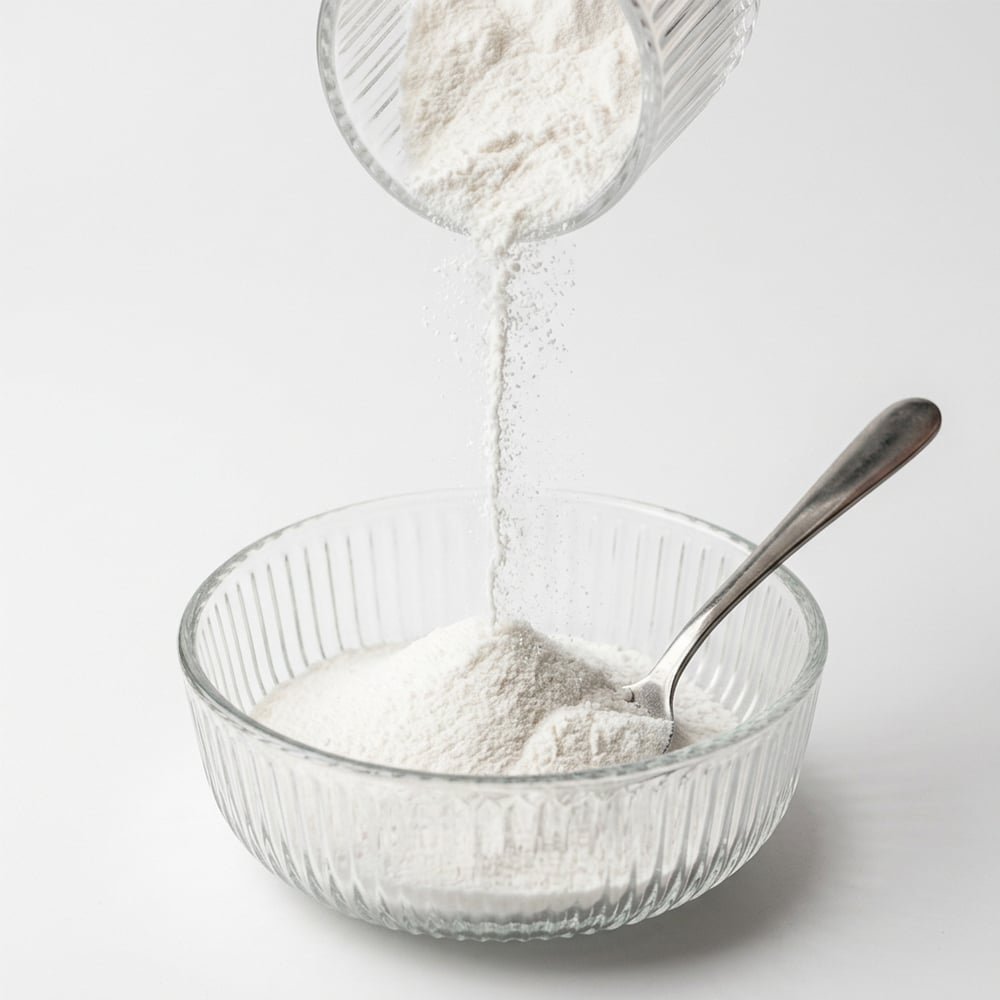
Maltodextrin is a carbohydrate ingredient produced through partial hydrolysis of starch sources — typically corn, but also potato, rice, or wheat depending on origin requirements. In its standard form, maltodextrin is a white or off-white free-flowing powder with a near-neutral taste, high water solubility, and the ability to function across a range of food, beverage, and pharmaceutical manufacturing applications. The defining specification for any maltodextrin product is its dextrose equivalent (DE) value, which measures the degree of starch hydrolysis and determines functional behavior in downstream formulation.
If you are evaluating maltodextrin for a specific application, the right question to ask first is not which supplier has the lowest price — it is whether the DE value you are considering actually matches the functional role maltodextrin needs to play in your formulation. Maltodextrin DE20 occupies a well-defined point on the hydrolysis spectrum: a DE value of 20 represents moderate hydrolysis, producing a product with mild sweetness, moderate solubility, and polymer chain lengths suited to spray-drying, encapsulation, and texture modification applications.
Demand for maltodextrin has grown alongside the expansion of convenience food, instant beverage, and meal replacement categories globally. Urban consumer lifestyles and the proliferation of on-the-go nutrition products have made maltodextrin one of the most consistently purchased carbohydrate ingredients in industrial food manufacturing — and supply consistency has become as important as specification compliance for buyers managing production schedules at scale.
Understanding the specific performance profile of maltodextrin DE20 helps procurement and formulation teams evaluate whether it fits their application before committing to a sourcing arrangement.
Maltodextrin serves different functional purposes depending on the application context. The following scenarios illustrate where maltodextrin DE20 is typically evaluated and what specification parameters matter most in each use case.
Spray-drying is one of the most demanding applications for maltodextrin as a processing ingredient. The maltodextrin polymer forms the wall matrix that encapsulates volatile flavors, essential oils, probiotics, or functional actives — protecting them from oxidation, moisture, and heat during drying and in the finished product. For standard spray-drying inlet temperatures, maltodextrin DE20 provides a matrix with glass transition characteristics suited to stable encapsulant formation. If your spray-drying conditions involve unusually high moisture loads or elevated outlet temperatures, verify whether maltodextrin DE20 maintains acceptable glass transition behavior under your specific process parameters before scaling to full production.
A recurring quality issue in spray-drying operations is DE value inconsistency across maltodextrin supply batches. Mixing maltodextrin from different suppliers — or from the same supplier with differing DE tolerances — can produce unpredictable variation in spray-drying yield and encapsulation efficiency. For production teams managing tight powder quality specifications, this is a cost risk best addressed during supplier qualification rather than through post-production rework.
In powdered beverage formulations — including sports nutrition drinks, instant meal bases, and functional powder blends — maltodextrin DE20 contributes solids, improves mouthfeel, and provides a neutral-tasting carbohydrate source that does not significantly alter the designed flavor profile. Its solubility characteristics make maltodextrin compatible with most standard beverage powder processing lines.
For dry-mix applications including instant soups, powdered seasonings, and dry-blend systems, maltodextrin also functions as a flavor carrier and flow aid, contributing to blend uniformity. In formulations where shelf-life management is a concern, maltodextrin can help control water activity within the product matrix — provided the final packaging is appropriately moisture-controlled for the storage environment.
Pharmaceutical and nutraceutical manufacturers evaluate maltodextrin as a direct compression tablet filler, wet granulation binder, and lyophilization support agent. In these applications, purity specifications, microbiological limits, and documentation requirements are typically more stringent than for food-grade maltodextrin use. Buyers sourcing maltodextrin for pharmaceutical excipient applications should confirm that the relevant pharmacopoeial standard applies and verify that supplier documentation can support their regulatory submission requirements. Maltodextrin meeting food-grade specifications is not automatically suitable for pharmaceutical applications without additional quality verification.
Selecting maltodextrin involves navigating several interdependent specification decisions. The following parameters form a practical evaluation framework for food and beverage ingredient procurement teams:
Evaluating a maltodextrin supplier involves more than product specification review. Technical support responsiveness, DE-grade selection guidance for spray-drying and encapsulation applications, and the ability to provide application-specific COA documentation are service capabilities that become relevant after procurement — particularly when formulation challenges arise that require fast supplier input. Selecting maltodextrin from a supplier with demonstrated application knowledge in your product category is a practical way to reduce technical risk.
Maltodextrin is produced through enzymatic hydrolysis of starch at industrial scale, and manufacturing capacity directly influences supply reliability for buyers with high or growing volume requirements. For food manufacturers managing continuous production lines, supply consistency — both in DE-grade quality and delivery scheduling — is a procurement risk factor that deserves explicit evaluation during supplier selection, not only at the time of a supply disruption.
For buyers sourcing maltodextrin for international or multi-market distribution, export documentation capability is a baseline requirement. Quality certifications, allergen declarations, COA traceability, and market-specific compliance documents should be verified as part of supplier qualification. A supplier's responsiveness to documentation requests during initial inquiry is often a reliable indicator of their overall process quality and service reliability.
As maltodextrin demand continues to grow alongside convenience food and functional nutrition manufacturing, securing reliable access to consistent DE-grade maltodextrin supply from a capable manufacturer is a sourcing decision with long-term operational value. Evaluating suppliers on production scale, quality system maturity, and technical support capability — alongside specification and price — positions buyers to manage formulation quality and supply continuity more effectively over time.

 EN
EN